
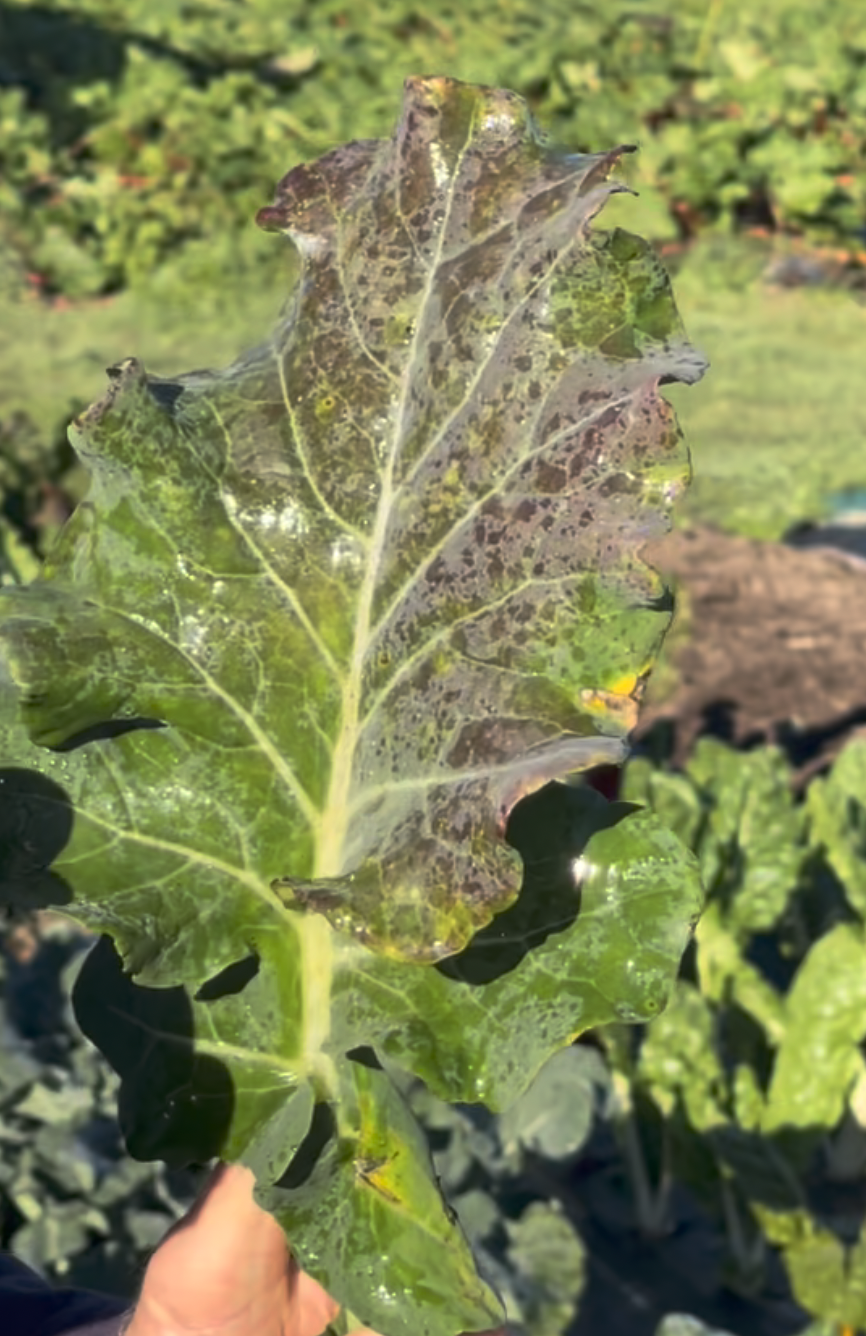
This cold time of year some of our broccoli plants do not grow to their potential and instead develop purplish tinged leaves, and produce small heads. This is due to a complex intersection between the micronutrient boron and the environment. Our plants only need boron in tiny amounts, but without it, things go wrong fast. Think of it as the broccoli's structural engineer. Its most important job is holding cell walls together. Every cell in a plant is essentially a water-filled balloon, and boron forms the molecular cross-links that keep those balloons firm and properly connected to each other. When boron is deficient, cell walls lose structural rigidity and integrity.
Boron also facilitates the loading and movement of sugars through plant membranes. When boron is deficient, sugar transport is impaired, so carbohydrates don't reach the plant's growing points - the places where new cells are rapidly produced. The developing head of a broccoli plant is exactly that: a mass of dividing cells with high sugar demand.
Boron also normally acts as a kind of chemical traffic controller for a group of plant compounds called phenols - defensive and structural chemicals the plant produces naturally. When boron is deficient, the plants are stressed and phenolic production goes into overdrive. The excess phenols cascade into producing red-purple pigments called anthocyanins, resulting in the purplish leaves, stem and heads.
Coastal soils in NSW are naturally boron-poor, due to centuries of rainfall leaching it out of the topsoil. We can also make things worse by heavy liming, because boron becomes chemically "locked up" in soil and unavailable to plants at higher pH levels, even when there's plenty of boron present. Plants grown on poorly drained or heavy clay soils do even worse, and cold weather seems to exacerbate things even more.
So here in the Homegrown Organics garden we are progressively adding tiny amounts of boron to our garden beds to correct this deficiency. If you are thinking of doing the same in your garden, I have an important caution for you: there is a very narrow gap between too little and too much boron in your soil. Overdosing causes its own toxicity problems. So I strongly suggest you get a soil or tissue test before you go adding any boron, then correct at the recommended rate.
Happy gardening!