
Our honey bee population has collapsed. The grass paths between our garden blocks are chock-a-block with clover flowers, and we're lucky to see a honey bee anywhere all day.
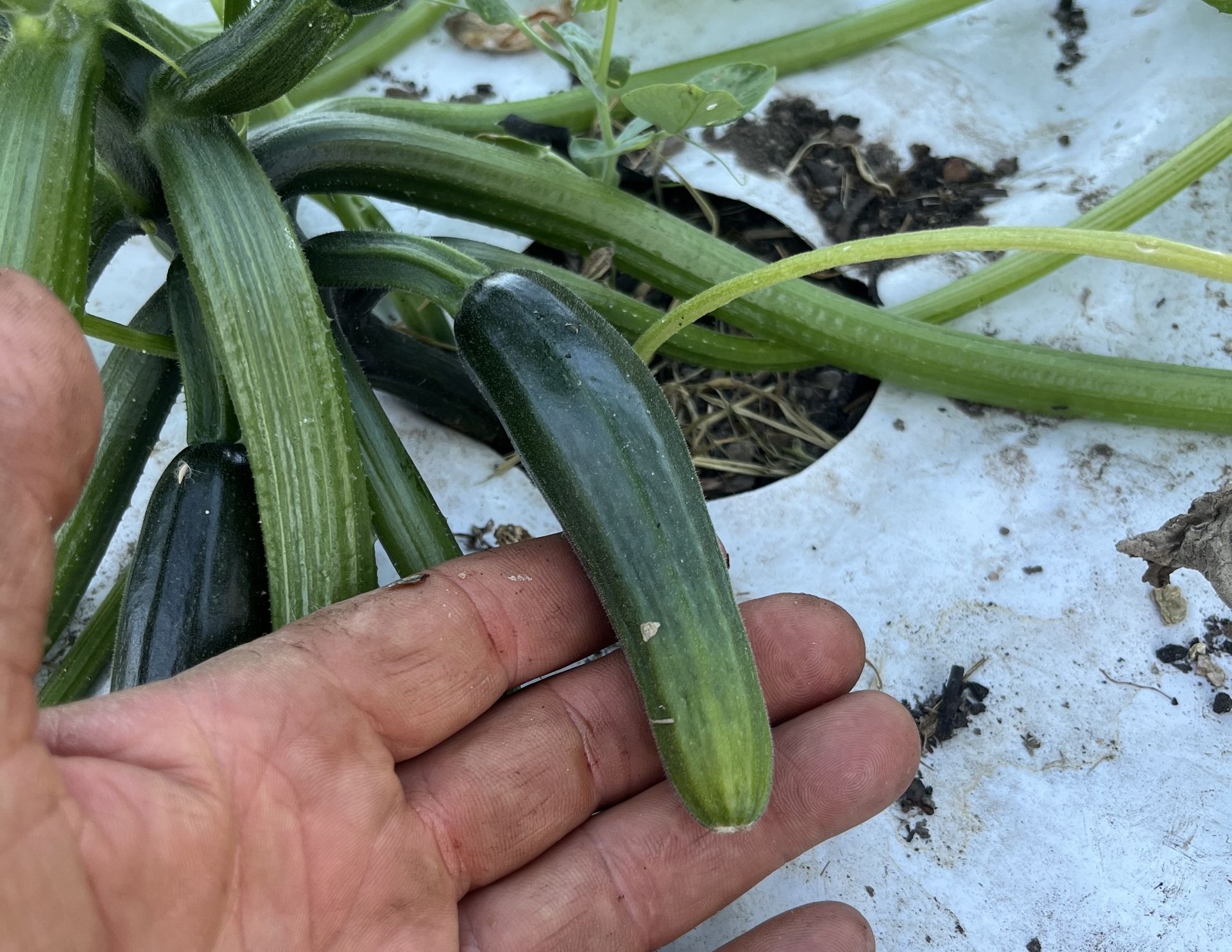
And certainly none buzzing around our zucchini blossoms - and that is a problem! Poorly pollinated or unpollinated zucchini flowers produce small, misshapen and deformed fruit that get squishy and shrivel on the pistil attachment end (opposite the stem), turn yellow, and fall off. Most are unsaleable.
Honey bee populations on the mid-north coast have been struggling for years with the Small Hive Beetle pest, which arrived in the country in 2002. Their larvae tunnel through the honeycomb, consuming the wax, honey, and pollen stores. They also eat bee brood, and contaminate the honey with a yeast from their faeces, causing it to ferment and become slimy. The stress and destruction caused by these beetles can weaken a colony to the point that it abandons the hive, or in severe cases, collapses entirely.
If that wasn't enough, in June 2022 the deadly varroa mite (Varroa destructor) arrived in Newcastle, and has since spread as far as Victoria and Queensland. Far more destructive even than the Small Hive Beetle, this 1-2mm long, flat, button-shaped parasite attaches to the bodies of honey bees and eats them alive - feeding on their host's vital organs (and on bee larvae) until the bee can no longer sustain it, at which point it transfers to another bee or another part of the colony. The mite also spreads at least five debilitating bee viruses.
In spite of best (though some believe misguided) efforts, the spread of this pest throughout the region has caused the collapse of European honey bee hives, both wild and cultivated. We haven't had hives here for some years, so the loss of our wild population is hurting us badly in the zucchini patch. Last summer was bad, this spring is patently worse.
In reality our honey bees are a feral species, introduced to Australia in the early 1800s, but we've become so used to their myriad blessings we forget they weren't originally here. Corresponding to their decline, we've noticed a dramatic increase in the number and variety of native bees. It's great to see these little fellas mount a comeback now their larger European competition is struggling. Sadly, they don't seem too interested in zucchini flowers, preferring the adjacent rhubarb flowers.
So we'll see how we go. Hopefully the processes of nature will result in honey bees that can coexist with the varroa mite, populations can recover, and apiarists can get back some normality. We'd also be happy if our native bees took a liking to zucchini flowers.